The Voice Problem
If you work in comms, content, or brand, you've been here: you need to write something for someone on the leadership team. An op-ed. A LinkedIn post. A company-wide email. A Forbes piece. Whatever it is, it needs to sound like them.
So you ask for their take. They're busy — genuinely busy, back-to-back meetings, running a company. So you get one of three responses:
A five-word Slack reply that tells you nothing. A bullet list pulled from a slide deck you've already seen. Or the classic: "Just use GPT."
So you do what comms people do. You go mining. Digging through Slack threads looking for a sentence where they accidentally said something interesting. Rewatching all-hands recordings hoping they went off-script for 30 seconds. Pulling from the same two or three podcast transcripts you've already squeezed dry. You stitch it together, fill in the gaps with assumptions, and produce something that's... fine. Technically correct. Sounds vaguely like a leader saying leader things.
But it doesn't sound like them. It can't. You're writing from scraps. Manufacturing a voice out of secondhand material and hoping nobody notices.
If you do this work, you know exactly what I'm talking about.
I came across a method from Ruben Hassid that reframed how I think about this problem. The core idea: use AI to extract someone's voice — deeply, specifically, relentlessly — by asking them how they think, write, and see the world. Not surface-level brand stuff. The real stuff. What they believe that's unpopular. What makes them cringe. How they talk when they're excited versus skeptical. The words they'd never use. Their actual opinions, not the sanitized versions.
You compile it into a voice profile — a comprehensive reference that captures their patterns, their instincts, their hard lines. Then you feed that into Claude — point Cowork at the folder, tell it to read the profile — and the output actually starts to sound like a person instead of a press release.
I ran this on myself recently. I sat down with Claude and answered a hundred questions about my own voice. It took a while. It was uncomfortable in the right ways. And the result was a document that captured things I didn't even know about my own writing — patterns I couldn't have articulated if you'd just asked me "how do you write?"
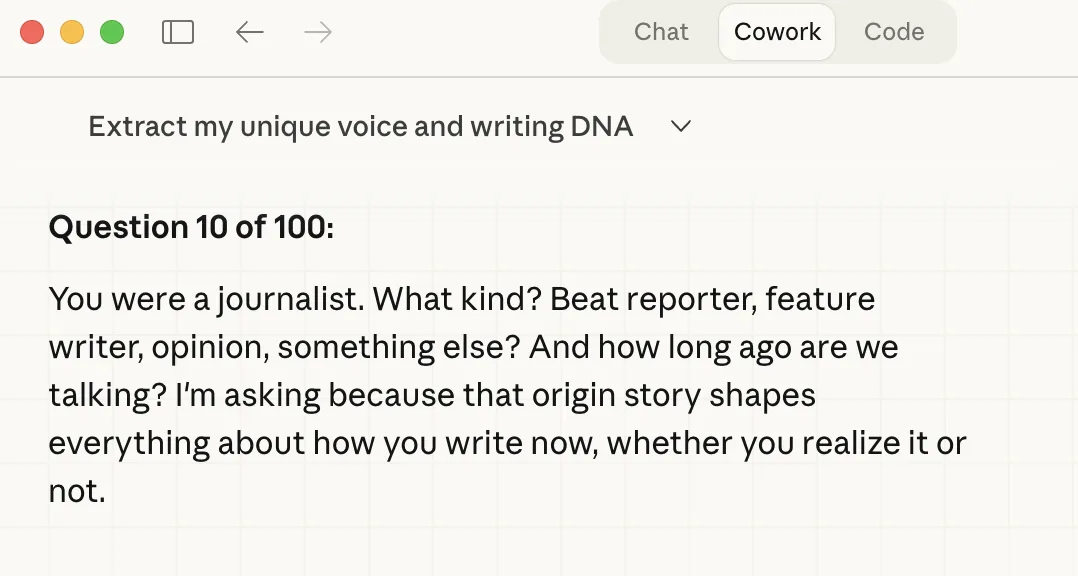
Here's what the process looks like, and how to adapt it for someone who doesn't have time for a hundred questions.
60 Questions, Done on Their Own
Ruben's strategy goes with 100 q's. Fifty or sixty will get you there if you ask the right ones. And the key: don't make it a meeting. Send them the questions as a document they paste into Claude. Claude runs the session — asks one question at a time, pushes back on safe answers, asks for examples, goes deeper when something interesting surfaces. No comms person in the room. No recorder. Just them and Claude.
The point is removing the performance pressure. A reserved person who won't open up across a conference table will often be surprisingly honest in a conversation with AI.
The categories that matter most:
Beliefs and hot takes (10 questions). What do they believe about the industry that most people don't? What conventional wisdom do they think is wrong? What hill would they die on? This is where the real POV lives — and it's almost never in their slide decks. The questions are designed to push past safe answers. If they write "we believe in putting the customer first," the follow-up question asks what that actually looks like when it's hard. When it costs something.
Voice and personality (10 questions). How do they sound when they're excited? What about when they disagree? Are they blunt or diplomatic? Do they use humor? The questions ask for specific examples. "Tell me about a time you disagreed with someone publicly — what did you say?" The answers here shape tone more than any brand guidelines doc ever will.
Aesthetic crimes (10 questions). What content do they hate? What makes them cringe? What phrases do they never want associated with them? This is just as important as knowing what they like. From my own session I discovered I'd never use words like "revolutionary" or "streamline" — stuff I couldn't have told you if you'd just asked. Everyone has these. They've just never been asked.
Hard lines (10 questions). What won't they talk about? What approaches feel wrong to them? What's beneath them? You need to know these or you'll accidentally cross one and lose their trust.
How they actually communicate (10 questions). Do they write in short bursts or long paragraphs? How do they use Slack? Do they use exclamation points? Emojis? Pull up their actual messages and look for patterns they can't see themselves.
Beyond the role (10 questions). What would they write about if it had nothing to do with their job? What are they reading that shapes how they think? What do their friends say they care about versus their colleagues? This is the section that turns a company voice profile into a person's voice profile. Not everything they write will be about the business — and even when it is, the stuff outside the role is what gives the writing texture.
The whole thing takes 60-90 minutes on their end. When the questions are done, Claude compiles everything into a structured voice profile — their beliefs, their patterns, their hard lines, a quick reference card of "always do this / never do this." The person sends you the finished voice-profile.md and the full conversation. Profile goes in the folder. Raw answers go alongside it — you'll want them when the profile feels thin on something.
Claude will get 80% right. The other 20% is where it smoothed out something important, missed a nuance, or organized something in a way that loses the feel. You know this person. Edit it yourself. Trust your ear over Claude's structure.
That document becomes the source of truth. Every piece of content written for them starts here.
The Ongoing Feed: This Is Where Most People Stop
The questions get you the foundation. But people aren't static. Someone has a conversation on Tuesday that shifts how they think about the market. They get fired up in a board meeting about something nobody expected. They read something that changes their mind.
If you're still writing from the same voice profile six months later without new input, you'll drift back to assumptions.
The system I'm building: the person keeps a running log. Doesn't need to be formal. Could be voice memos transcribed through Whispr or any dictation tool. A shared doc where they drop a few sentences when something hits them. A weekly five-minute brain dump — "here's what I was thinking about this week." It takes less time than replying to a Slack thread.
You drop each week's input as a dated file in their folder. Next time you open Cowork and ask it to write something, it reads the voice profile and the raw input fresh. No processing step, no summaries. The raw material is the system.
It replaces the Slack mining, the all-hands scraping, the recycled transcripts. Fresh, real, their material every week.
What This Actually Produces
The difference between writing for someone with a voice profile and ongoing feed versus writing without one is the difference between a cover band and the actual artist.
Without it, you're guessing. Writing what you think they'd say based on fragments. The output is safe, generic, interchangeable with any other leader in the industry.
With it, you're writing from their actual beliefs, in their actual rhythm, with their actual hard lines respected. The op-ed has a real opinion in it. The internal email sounds like the person the team actually talks to every day. The LinkedIn post has a point of view that could only come from one person.
That's the whole game. Not making people sound smart. Making them sound like themselves.
If you're the exec: the reason your comms person's drafts don't sound like you isn't because they're bad at their job. It's because you haven't given them the real stuff. The five-word Slack reply isn't enough. "Just use GPT" definitely isn't enough. Paste 50 questions into Claude and have a conversation — on your own time, at your own pace. Give them five minutes a week after that. The ROI on those five minutes is every piece of content with your name on it actually sounding like it came from you.
If you're the comms person: stop mining Slack. Stop guessing. Build the system. Send them the questions. Let Claude do the interviewing. Set up the weekly feed. Your job gets easier and the work gets better. That almost never happens at the same time.